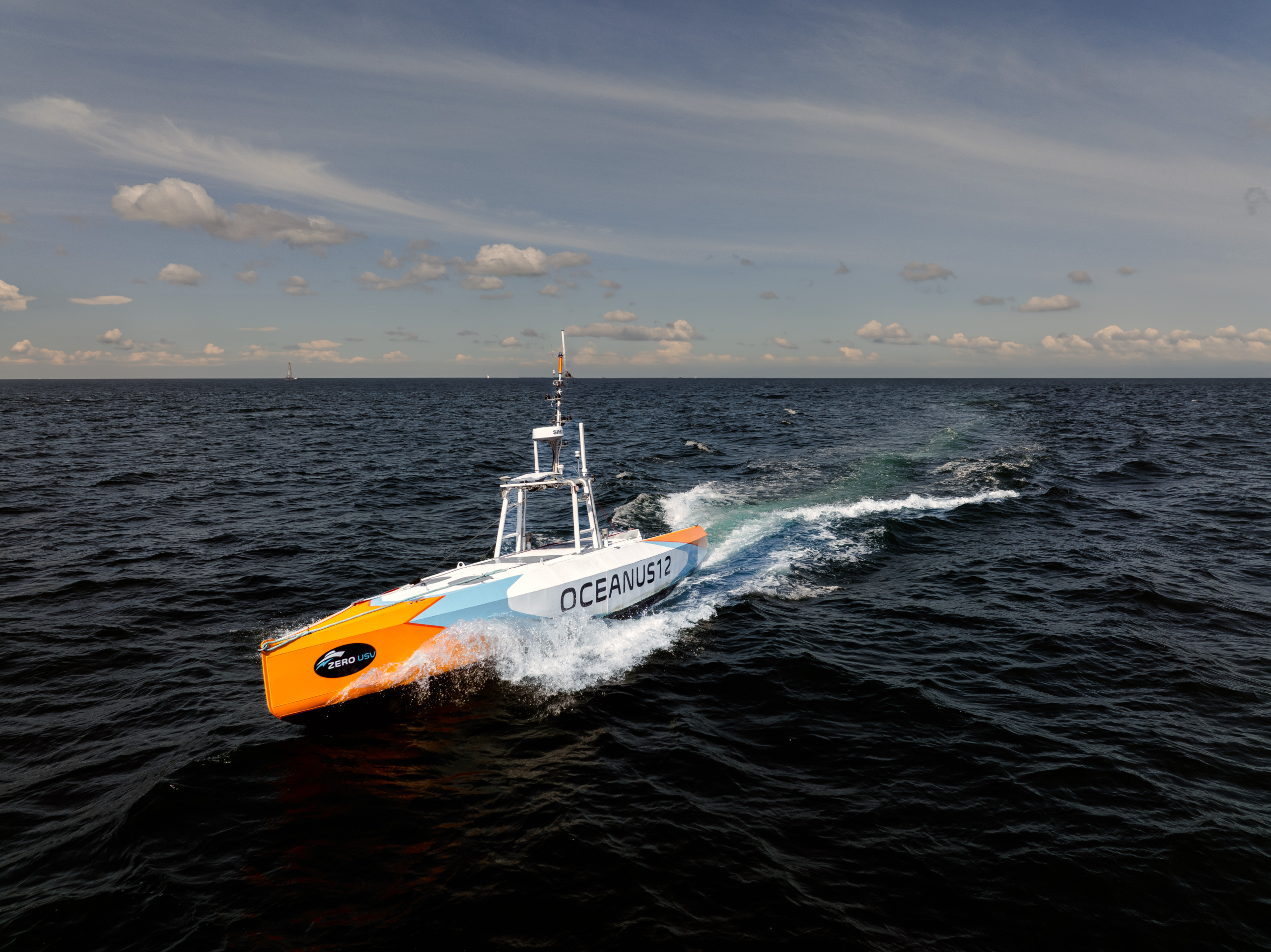
Artificial intelligence is changing maritime operations by helping vessels and shore-based teams interpret information faster, identify risks earlier, optimise operations and automate tasks that have traditionally depended heavily on human intervention.
Its impact extends well beyond autonomous ships.
AI is increasingly relevant to crewed vessels, uncrewed platforms, ports, offshore operations, defence, hydrographic surveying and environmental monitoring. It can support the people operating vessels as well as enable machines to undertake missions independently.
The result is a gradual shift from maritime operations that primarily collect and display information towards systems capable of understanding information and helping decide what should happen next.
What is maritime AI?
Maritime AI is the application of artificial intelligence to vessels and marine operations to interpret data, support decisions, automate processes and improve safety, efficiency and operational capability.
Traditional marine systems are extremely good at providing information. Radar detects targets. AIS reports vessel information. GPS establishes position. Cameras provide a visual picture. Machinery monitoring systems report the condition of equipment.
The challenge is that people still have to interpret much of this information.
AI introduces an additional layer.
Instead of simply presenting data, intelligent software can analyse it, identify patterns, prioritise what matters and support an appropriate response.
That distinction is fundamental to understanding how AI is transforming maritime operations.
The value of maritime AI is not simply having more data. It is extracting more useful intelligence from the data already available.
Where is AI being used in maritime operations?
AI applications in the maritime sector now extend across a wide range of activities, including:
- navigation and decision support;
- situational awareness;
- autonomous and uncrewed vessel operations;
- route and voyage optimisation;
- collision-risk assessment;
- machinery and predictive maintenance;
- remote vessel operations;
- fleet management;
- hydrographic surveying;
- offshore inspection;
- environmental monitoring;
- defence and maritime security; and
- analysis of operational data.
Not every application requires a fully autonomous vessel.
This is an important distinction.
Some of the most immediate opportunities for maritime AI involve augmenting existing vessels and crews, giving people better information and helping them make decisions more effectively.
How can AI improve safety at sea?
One of the most significant applications of AI is improving the speed and quality of maritime decision-making.
A modern bridge can receive information from numerous sources simultaneously. Radar, AIS, electronic charts, cameras, navigation equipment, weather information and communications may all be competing for the attention of the bridge team.
More information does not automatically mean greater safety.
In a complex situation, the real requirement is to identify which information matters now.
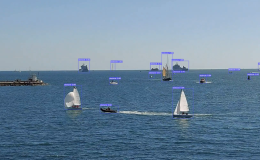
AI can help by analysing multiple streams of information and highlighting developing risks or situations requiring attention.
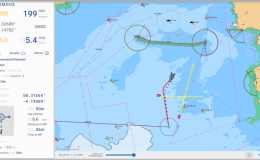
For example, rather than simply displaying the tracks of surrounding vessels, an intelligent system can help identify which contacts are operationally relevant, which are likely to interact with the vessel’s route and which may require closer attention.
This changes AI from another source of information into a decision-support layer.
For experienced mariners, that distinction matters. The objective should not be to overwhelm a bridge team with additional alerts and displays, but to help people understand a complex situation more quickly.
Does maritime AI replace the crew?
Not necessarily.
The development of autonomous vessels sometimes creates the impression that the ultimate purpose of maritime AI is to remove people from ships.
In reality, AI can operate across a spectrum.
At one end, it can provide relatively focused decision support to the crew of a conventional vessel. At the other, it can enable an uncrewed vessel to perform complex missions with a high degree of autonomy.
Between those two extremes are many different combinations of people and automation.
A crewed vessel might use AI to improve situational awareness or support navigational decisions.
Another vessel might automate certain routine functions while retaining a crew aboard.
An uncrewed vessel might operate autonomously for parts of its mission while remaining under human supervision from shore.
The question is therefore not simply whether AI will replace mariners.
A more useful question is:
Which tasks should be performed by people, which can be performed by intelligent systems, and how should the two work together?
How is AI changing decision-making on the bridge?
Traditional bridge technology has progressively increased the amount of information available to mariners.
AI creates the opportunity to move beyond displaying that information towards interpreting it.
Imagine a vessel approaching a busy area with multiple contacts around it.
A conventional system may show the bridge team the position, course and speed of surrounding vessels. An intelligent system can go further by analysing how the situation is developing and helping identify which interactions are likely to become important.
The difference is between:
“Here is the information.”
and:
“Here is the information that requires your attention.”
That has important implications for cognitive workload.
Mariners remain responsible for making critical decisions in many operations, but AI can help reduce the amount of routine interpretation required before those decisions are made.
The best maritime AI should therefore make the operational picture clearer rather than busier.
How does AI enable autonomous vessel operations?
Autonomous vessels represent one of the most visible applications of maritime AI.
Artificial intelligence allows a vessel to perform tasks that would otherwise require people aboard, from interpreting its operating environment to making decisions during a mission.
However, autonomous navigation is a substantial topic in its own right.
Our guide to How Autonomous Surface Vessels Navigate Without a Crew explains how positioning, environmental perception, intelligent decision-making, vessel control and communications combine to enable autonomous navigation.
Similarly, our article on Sensor Fusion for Autonomous Vessels looks specifically at how multiple sources of information can be combined to build maritime situational awareness.
The wider significance is that AI allows some maritime operations to be redesigned around the mission rather than around the requirement to accommodate people aboard the vessel.
That can fundamentally change what is practical at sea.
How can AI remove people from hazardous environments?
Some maritime activities expose personnel to significant risk simply because a person needs to be physically present to operate the vessel.
This is particularly relevant to missions involving:
- difficult sea conditions;
- remote locations;
- long-duration operations;
- defence and security;
- offshore infrastructure;
- repetitive surveying;
- potentially contaminated environments; and
- other hazardous operating areas.
Autonomous and remotely operated vessels create the possibility of carrying out some of these missions without putting personnel aboard the platform itself.
This does not mean removing humans from the operation entirely.
Instead, people can potentially supervise the mission from a safer location while the vessel performs the task at sea.
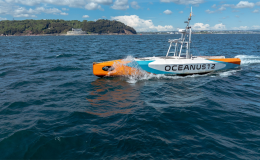
Marine AI’s work with autonomous and uncrewed vessels demonstrates how this model can be applied across commercial, defence and scientific applications.
How is AI improving maritime efficiency?
Efficiency at sea involves much more than travelling from A to B as quickly as possible.
Operators must consider fuel consumption, weather, sea state, vessel performance, mission objectives, traffic, schedules and numerous other constraints.
AI can analyse these variables together.
This creates opportunities to optimise operations dynamically rather than relying entirely on fixed assumptions made before departure.
Potential applications include:
Route optimisation
Intelligent software can help identify more efficient routes based on changing operational conditions.
Energy optimisation
Speed, route and vessel behaviour can potentially be adjusted to reduce unnecessary fuel or energy consumption.
Mission optimisation
Survey, monitoring and inspection missions can be planned around the most effective use of the vessel and its onboard equipment.
Asset utilisation
Fleet data can help operators understand how vessels are being used and identify opportunities to improve deployment.
The important point is that optimisation becomes a continuous process.
Rather than simply executing a plan, an AI-enabled operation can potentially respond as circumstances change.
Can AI reduce the environmental impact of maritime operations?
Greater operational efficiency can also have environmental benefits.
Reducing unnecessary fuel consumption, optimising routes and deploying appropriately sized vessels for particular tasks can all contribute to lower emissions.
Autonomous vessels can create additional opportunities.
A mission that traditionally requires a relatively large crewed vessel may, in some circumstances, be achievable using a smaller uncrewed platform.
That can significantly change the energy requirements associated with collecting data, carrying out inspections or maintaining a persistent presence at sea.
AI can also contribute directly to environmental work.
Autonomous and intelligent vessels can support:
- water-quality monitoring;
- marine habitat surveys;
- pollution detection;
- oceanographic research;
- marine litter monitoring;
- seabed mapping; and
- long-duration environmental data collection.
AI therefore has the potential both to reduce the footprint of maritime operations and improve our ability to understand the marine environment.
How is AI changing offshore operations?
Offshore operations frequently involve sending people and vessels considerable distances to inspect, survey or monitor assets.
AI-enabled vessels create an alternative approach.
Autonomous or remotely supervised platforms can potentially carry sensors and specialist equipment to offshore locations without requiring a conventional crew aboard.
This can support activities around offshore wind farms, subsea infrastructure, energy installations and other marine assets.
The advantage is not simply automation for its own sake.
The operational model can become different.
Smaller intelligent platforms can potentially undertake persistent or repeated missions that would be expensive or impractical using conventional crewed vessels.
For asset operators, this creates opportunities for more frequent data collection and a better understanding of infrastructure condition over time.
How is AI transforming hydrographic surveying and ocean science?
Marine surveying is particularly well suited to autonomous technology because many missions involve vessels systematically following planned patterns while collecting data.
An autonomous vessel can potentially perform these repetitive missions for extended periods while specialist personnel concentrate on the resulting information rather than physically operating the survey platform.
AI can support:
- mission planning;
- vessel operation;
- adaptive survey behaviour;
- data quality monitoring;
- object identification; and
- analysis of large datasets.
For ocean science, the implications are equally significant.
Researchers are often constrained by ship time, crew availability, cost and the practical difficulty of maintaining a presence in remote areas.
Long-endurance autonomous platforms can potentially collect information over much longer periods.
That changes not only how efficiently data is collected, but potentially how much data can be collected in the first place.
What role does AI play in maritime defence and security?
Defence is another area where the combination of autonomy, AI and uncrewed vessels can fundamentally change operational models.
Uncrewed platforms can support missions including surveillance, reconnaissance, monitoring and other tasks where persistence, scale or reduced risk to personnel are valuable.
AI can help these platforms interpret information, perform missions and operate with reduced levels of continuous human control.
There is also a significant question of scale.
Traditional maritime capability is closely linked to the number of vessels and personnel available. Increasing autonomy creates the possibility of deploying larger numbers of distributed platforms without increasing personnel requirements at the same rate.
This does not remove human command or responsibility.
Instead, AI can enable people to operate at a different level: setting mission objectives and supervising systems rather than manually controlling every individual platform continuously.
How does AI enable remote maritime operations?
AI also changes what is possible from shore.
As onboard systems become capable of handling more routine functions independently, shore-based personnel can increasingly supervise the operation rather than continuously control every movement of a vessel.
This creates the potential for a different relationship between vessel and operator.
Our guide to Remote Operation Centres: How Autonomous Vessels Are Controlled from Shore explores this subject in detail, including remote supervision, human intervention and the potential for personnel to oversee multiple autonomous assets.
The broader transformation is significant.
Traditionally, maritime expertise has often needed to travel with the vessel.
Increasingly, some of that expertise can potentially be delivered to the vessel digitally from shore.
Can AI help manage fleets rather than individual vessels?
One of the next major stages in maritime AI is likely to involve moving from individual intelligent vessels towards intelligent fleets.
If multiple vessels can operate with increasing autonomy, their activities can potentially be coordinated at fleet level.
Instead of an operator manually directing each asset, the system could help allocate missions according to factors such as:
- vessel location;
- capability;
- remaining fuel or energy;
- mission priority;
- environmental conditions;
- equipment availability; and
- operational risk.
Information gathered by one vessel could also contribute to the wider operational picture available to others.
This creates the possibility of collaborative maritime autonomy, where the value comes not simply from making one vessel intelligent but from coordinating multiple intelligent assets.
For defence, offshore monitoring, surveying and environmental applications, that could represent a significant change in operational capability.
How can AI improve vessel maintenance?
Not all maritime AI applications concern navigation.
Modern vessels generate substantial amounts of machinery and operational data.
AI can analyse patterns within that data to identify behaviour that may indicate developing problems.
This can support a shift from scheduled maintenance towards more predictive approaches.
Rather than servicing equipment solely according to a predetermined interval, operators can increasingly use information about actual equipment condition and performance to help determine when attention is required.
Potential benefits include:
- earlier identification of faults;
- reduced unplanned downtime;
- better maintenance planning;
- improved asset availability; and
- more effective use of components.
For autonomous vessels, system-health monitoring becomes particularly important because there may be nobody aboard to physically investigate a developing fault.
What are the challenges of using AI at sea?
The maritime environment places demanding requirements on technology.
AI systems may have to operate with:
- intermittent communications;
- changing weather;
- poor visibility;
- vessel motion;
- saltwater exposure;
- complex traffic;
- incomplete information; and
- safety-critical consequences.
Reliability therefore matters enormously.
An AI system also needs to communicate effectively with the people using it.
A technically sophisticated system that produces excessive alerts or cannot explain which information requires attention may increase rather than reduce workload.
Cybersecurity, regulation, validation, connectivity and the availability of appropriate training data are also important considerations.
For maritime AI to succeed, it needs to be more than intelligent in laboratory conditions.
It needs to be dependable in the real world at sea.
Is AI the same as maritime autonomy?
No. Artificial intelligence and maritime autonomy are related, but they are not interchangeable terms.
Artificial intelligence describes systems capable of analysing information, recognising patterns, making predictions or supporting decisions.
Maritime autonomy refers to the ability of a vessel or maritime system to perform functions with reduced human intervention.
AI can enable autonomy, but it can also be used on a fully crewed vessel.
Similarly, not every automated function necessarily requires artificial intelligence.
This distinction is important because the maritime industry’s adoption of AI is likely to be much broader than the adoption of fully autonomous ships.
AI can deliver value long before a vessel becomes uncrewed.
What is the future of AI in maritime operations?
The future of maritime AI is likely to involve a gradual increase in the intelligence distributed across vessels, fleets and shore-based operations.
Crewed vessels will increasingly gain intelligent decision-support tools.
Uncrewed vessels will become capable of undertaking more complex missions.
Remote Operation Centres will allow expertise to be applied from shore.
Multiple autonomous assets will increasingly be coordinated as fleets.
Operational data will be used not simply to report what happened, but to predict what is likely to happen next.
The result will not necessarily be a maritime industry without people.
Instead, the more profound change may be a maritime industry in which people spend less time gathering and interpreting routine information and more time making the decisions where human judgement adds the greatest value.
How Marine AI is helping transform maritime operations
Marine AI develops autonomy software designed to bring intelligence into both crewed and uncrewed vessel operations.
The GuardianAI™ Software Suite provides a scalable approach to maritime autonomy, supporting applications ranging from enhanced situational awareness and decision support aboard crewed vessels to remote and autonomous operation of uncrewed platforms.
Marine AI technology has already been applied to projects including the Mayflower Autonomous Ship and a range of autonomous vessel programmes, demonstrating how AI can move beyond experimental applications into real-world maritime operations.
The common principle is straightforward:
AI should help vessels and the people responsible for them make safer, smarter and more effective decisions.
As maritime operations become increasingly connected and data-rich, the organisations that benefit most from AI are unlikely to be those that simply collect the most information.
They will be those that can turn that information into useful intelligence — and useful intelligence into action.
Frequently Asked Questions
What is AI used for in the maritime industry?
AI is used in maritime operations for decision support, situational awareness, autonomous navigation, route optimisation, predictive maintenance, remote operations, fleet management, surveying, environmental monitoring and maritime security.
How is AI improving maritime safety?
AI can analyse information from multiple vessel systems to identify patterns, developing risks and situations requiring attention. This can help crews and autonomous systems understand complex operating environments and make more informed decisions.
Will AI replace ship crews?
AI does not necessarily replace ship crews. It can support people aboard conventional vessels, automate particular tasks, enable remote operations or allow some vessels to operate without a crew. The appropriate level of automation depends on the vessel and mission.
What is the difference between maritime AI and maritime autonomy?
Maritime AI uses artificial intelligence to analyse information and support or make decisions. Maritime autonomy refers to a vessel or system performing functions with reduced human intervention. AI can enable autonomy but can also provide decision support aboard crewed vessels.
Can AI make shipping more sustainable?
AI can support more sustainable maritime operations by optimising routes, speed, energy use and vessel deployment. Autonomous technology may also allow some missions to be performed by smaller uncrewed vessels rather than larger crewed platforms.
How is AI used on autonomous vessels?
AI can help autonomous vessels interpret their surroundings, assess situations, make operational decisions and complete missions with reduced human intervention. It can work alongside navigation, sensing, communications and vessel-control systems.
What is the future of AI in maritime operations?
AI is likely to become increasingly integrated across crewed vessels, autonomous vessels, shore-based operations and fleets. Its role will expand from analysing individual systems towards coordinating operations, predicting risks and supporting increasingly complex maritime decisions.