Autonomous vessels may operate without a traditional crew on board, but that does not necessarily mean humans disappear from the operation. Instead, many of the functions traditionally carried out from a ship’s bridge can be monitored, supervised or controlled from a Remote Operation Centre (ROC) on shore.
A Remote Operation Centre provides shore-based personnel with access to vessel status, mission information, communications and operational controls. Depending on the vessel and its level of autonomy, operators may continuously control the vessel, supervise autonomous systems, respond to alerts or intervene when human judgement is required.
As maritime autonomy develops, Remote Operation Centres are therefore becoming an important part of the infrastructure that connects autonomous vessels with the people responsible for their safe operation.
What is a Remote Operation Centre?
A Remote Operation Centre (ROC) is a shore-based location from which operators can monitor, supervise or control some or all of the functions of an autonomous or remotely operated vessel.
The International Maritime Organization (IMO) defines a Remote Operations Centre as a location remote from a Maritime Autonomous Surface Ship (MASS) that can operate some or all aspects of its functions. (imo.org)
The precise role of the ROC depends on how the vessel has been designed to operate.
At one end of the spectrum, a remote operator may directly control a vessel much as a crew member would control it from a bridge. At the other, a highly autonomous vessel may independently follow its mission while shore-based personnel supervise its progress and intervene only when necessary.
This distinction is important. Remote operation and autonomous operation are not the same thing.
What is the difference between a remote-controlled and autonomous vessel?
A remotely controlled vessel relies on a human operator in another location to perform functions that would traditionally be carried out on board. An autonomous vessel can perform some of those functions itself using onboard systems.
IMO has previously described four broad degrees of maritime autonomy, ranging from ships with automated processes and crew on board through to remotely controlled vessels without seafarers and fully autonomous ships capable of making decisions themselves. (imo.org)
In practice, maritime autonomy does not have to be an all-or-nothing proposition.
A vessel might navigate autonomously during routine parts of a mission while a remote operator retains oversight. Alternatively, a vessel may operate primarily under remote control while autonomous systems assist with particular tasks.
The relationship between human control and machine autonomy can therefore change according to the vessel, mission, operating environment and circumstances.
How are autonomous vessels controlled from shore?
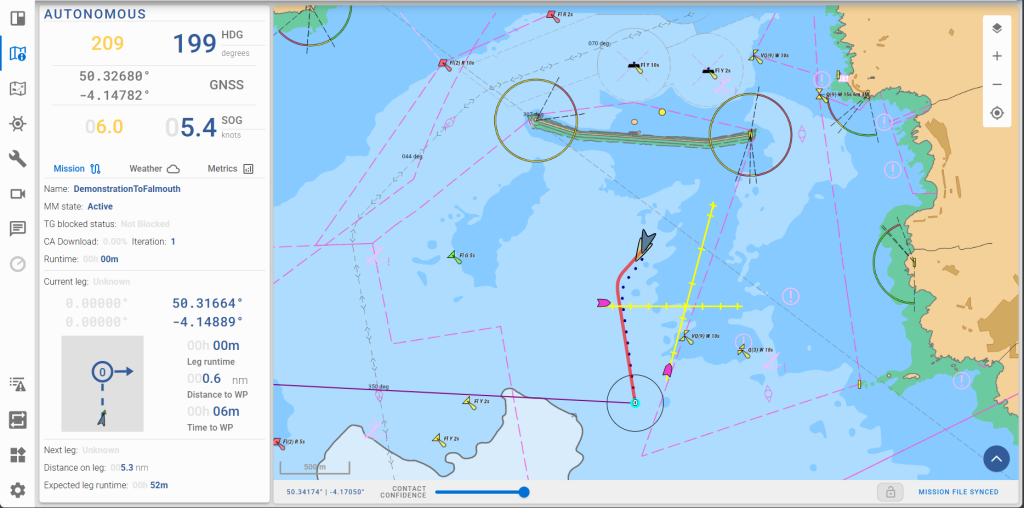
Communication between the vessel and the Remote Operation Centre allows operational information to move in both directions.
The vessel can transmit information such as:
- position, heading and speed;
- vessel and system status;
- mission progress;
- alarms and warnings;
- camera or other relevant operational feeds; and
- information required by the remote operator to understand the vessel’s current situation.
Commands can then travel in the opposite direction, allowing authorised personnel to alter mission parameters or, where the system is designed for it, control vessel functions remotely.
Exactly what information is transmitted and what controls are available depends on the vessel and its operating concept.
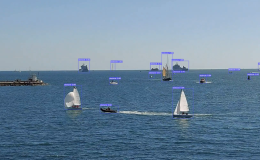
For example, Marine AI’s GuardianAI™ Lite is designed for smaller remotely operated USVs. Its Sense layer creates a contact picture from onboard information for use by both the system and operator, while its Act layer allows vessel movements to be controlled from a Remote Operating Centre using either autopilot or individual thruster and actuator control. (Marine AI)
This illustrates an important feature of modern remote operations: the ROC does not simply reproduce a conventional bridge on land. It can provide a digital interface between the human operator and increasingly intelligent onboard systems.

What does a remote vessel operator actually do?
The responsibilities of a remote operator depend on the level of autonomy and the operational concept of the vessel.
Typical responsibilities may include:
Mission supervision
The operator can monitor whether the vessel is following its intended mission and identify deviations or changing operational requirements.
Vessel monitoring
Information from onboard systems allows shore personnel to understand the condition and status of the vessel.
Responding to alerts
Autonomous systems can notify operators when a situation requires attention rather than requiring them to continuously perform every aspect of vessel control.
Mission changes
Where authorised, shore personnel may amend waypoints, operating parameters or other elements of the mission.
Remote intervention
Some vessels allow an operator to take direct or assisted control when circumstances require human involvement.
Communications and coordination
Remote personnel can form the human interface between the vessel and wider operational teams.
This creates a fundamentally different role from that of a conventional bridge team.
Rather than physically operating every system aboard the vessel, the remote operator may increasingly supervise automation and manage exceptions.
Does an autonomous vessel always need human supervision?
The answer depends on its design, regulatory requirements, mission and intended level of autonomy.
A fully autonomous system may be technically capable of making decisions and determining actions itself. However, the regulatory framework for Maritime Autonomous Surface Ships continues to place significant importance on human responsibility and oversight.
The IMO’s MASS Code, adopted in May 2026 and effective from 1 July 2026 as a non-mandatory instrument, establishes a framework for remotely controlled and autonomous commercial ships. Among other things, it addresses remote operations, connectivity, cybersecurity and human oversight. (imo.org)
Significantly, the framework maintains the principle that a human master remains responsible for the vessel even when that person is not physically on board. (imo.org)
The evolution of autonomy is therefore better understood as a change in where and how humans interact with vessels, rather than simply the removal of people from maritime operations.
What information can a Remote Operation Centre receive?
A remotely operated or autonomous vessel can generate significant amounts of operational data.
Depending on the system, information available ashore may include vessel position and movement, mission status, propulsion information, system health, alarms, communications and selected information from onboard sensing systems.
The objective is to provide the operator with sufficient information to understand the vessel’s operational state and make appropriate decisions.
This is where there is an important distinction between a Remote Operation Centre and the autonomous technology aboard the vessel.
Onboard autonomous systems can process information locally to understand the operating environment and make appropriate decisions. We explore this process in more detail in Sensor Fusion for Autonomous Vessels: How AI Builds Situational Awareness at Sea.
The ROC provides the human interface to the wider autonomous system.
This article therefore focuses on human supervision and remote operation rather than repeating how onboard sensors and AI create situational awareness.
What happens if communication with the vessel is lost?
Reliable connectivity is clearly important for remote vessel operations, but an autonomous vessel should not necessarily become helpless if a communications link is temporarily unavailable.
The appropriate response depends on how the vessel and mission have been designed.
A vessel might, for example, be configured to continue an authorised mission, maintain a safe state, follow predetermined contingency behaviour or take another defined action if communications are degraded.
This highlights one of the fundamental differences between remote control and autonomy.
A purely remotely controlled system may depend much more heavily on continuous communications. A more autonomous system can potentially retain greater onboard decision-making capability when its connection to shore is disrupted.
Resilience therefore needs to be considered across the whole system: vessel, software, communications infrastructure and Remote Operation Centre.
Can one operator control several autonomous vessels?
One of the potential advantages of higher levels of autonomy is that human operators may not always need to give their full attention to a single vessel.
Instead, autonomous systems can perform routine functions while personnel supervise operations and respond when intervention is required.
This creates the possibility of a Remote Operation Centre overseeing multiple vessels.
However, this is not simply a question of displaying more vessels on additional screens.
Workload, communications, alarms, human-machine interfaces, vessel behaviour and the complexity of the operating environment all influence how many vessels can safely be supervised.
IMO discussions have recognised the possibility that a master at a Remote Operations Centre could be responsible for multiple MASS under appropriate conditions, although the circumstances and requirements around such operations require careful consideration. (imo.org)
The long-term significance could be considerable.
Instead of scaling maritime operations by adding a complete onboard crew to every additional vessel, increasingly autonomous fleets could potentially allow skilled personnel ashore to oversee several assets.
What happens when an autonomous vessel needs human intervention?
One of the most important capabilities of a Remote Operation Centre is providing a route for human intervention.
Autonomous systems can be designed to handle expected situations within their defined operating parameters. However, maritime environments are complex, and there may be circumstances where human judgement or direct control is appropriate.
The vessel may alert an operator when a situation falls outside predetermined parameters or requires review.
The human can then assess the information available and take an appropriate action according to the system’s capabilities and operational procedures.
This concept is sometimes described as human-in-the-loop or human-on-the-loop operation.
In a human-in-the-loop system, a person may be required to approve or make certain decisions.
In a human-on-the-loop system, the autonomous technology performs more functions independently while the human supervises the process and retains the ability to intervene.
The balance between these approaches will depend on the application.
How important is connectivity to remote vessel operations?
Connectivity is one of the foundations of remote maritime operations.
Data must be able to move between the vessel and shore with sufficient reliability for the particular operational function being performed.
However, different functions may have very different communications requirements.
Transmitting an occasional vessel status update is very different from providing information required for direct real-time remote control.
This means connectivity architecture has to reflect the operational concept of the vessel.
It also explains why increasing onboard autonomy can be valuable. The more effectively a vessel can process information and perform appropriate functions locally, the less every operational decision has to depend on a continuous high-bandwidth connection to shore.
The IMO’s 2026 MASS Code specifically identifies connectivity among the areas that must be considered in the safe design and operation of autonomous and remotely operated ships. (imo.org)
Are Remote Operation Centres regulated?
Remote operations are becoming an increasingly important part of the developing international regulatory framework for autonomous shipping.
The IMO’s MASS Code introduces a global framework covering remotely controlled and autonomous commercial ships. Remote Operation Centres form an explicit part of that framework, alongside areas including navigation, connectivity, cybersecurity and human oversight. (imo.org)
The Code also emphasises that Remote Operation Centres should be assessed, certified and operated under an appropriate Safety Management System. (imo.org)
The non-mandatory MASS Code represents an important step towards a future mandatory international framework.
For operators and technology developers, this reinforces an important point: the Remote Operation Centre should be considered part of the overall autonomous vessel system, not simply an office containing screens and controls.
How do Remote Operation Centres improve maritime operations?
Moving appropriate vessel functions ashore can potentially change the economics, safety and scalability of some maritime operations.
Potential advantages include:
Reduced exposure to hazardous environments
Some missions can be undertaken without placing personnel aboard vessels operating in dangerous, remote or difficult conditions.
Centralised expertise
Specialists can potentially support maritime operations from a shore facility rather than needing to travel aboard every vessel.
Greater operational scalability
Increasing autonomy creates the potential for personnel to supervise more than one vessel, subject to the appropriate safety and regulatory requirements.
Improved access to operational information
Digital interfaces can bring vessel status, mission information and alerts together in a form designed around the needs of remote personnel.
Closer integration between humans and autonomy
Operators can concentrate on decisions that benefit from human judgement while autonomous systems perform suitable routine functions.
The objective is not simply to replace the conventional bridge with a remote version of the same thing.
The greater opportunity is to rethink how people and autonomous technology share responsibility for maritime operations.
How do Remote Operation Centres fit into maritime autonomy?
A useful way of understanding autonomous vessel technology is as a connected system rather than a single piece of software.
An autonomous vessel needs to understand where it is, perceive what is happening around it, make appropriate decisions and control the vessel accordingly.
We explain that overall process in How Autonomous Surface Vessels Navigate Without a Crew, while our guide to Sensor Fusion for Autonomous Vessels looks specifically at how information from multiple sources can be combined to create situational awareness.
The Remote Operation Centre adds another crucial element:
human oversight.
It connects the autonomous vessel with the people responsible for supervising the mission and, where necessary, intervening.
As autonomous maritime technology develops, the bridge may therefore not disappear.
It may move ashore.
The future of Remote Operation Centres
The role of the Remote Operation Centre is likely to evolve alongside the capabilities of autonomous vessels themselves.
Early remote operations can require substantial human involvement. As autonomy becomes more capable, the relationship can shift from continuous vessel control towards mission supervision and exception management.
That could ultimately allow shore-based teams to oversee increasingly sophisticated fleets of autonomous vessels operating across different missions and locations.
The technology alone, however, is only part of the challenge.
Successful remote maritime operations require appropriate human-machine interfaces, resilient communications, cybersecurity, clear operational responsibilities and systems designed to behave safely when circumstances change.
The adoption of the IMO MASS Code in 2026 is a significant indication of the direction of travel: autonomous shipping is increasingly being considered not just in terms of what happens aboard the vessel, but as a complete operational system incorporating both onboard autonomy and shore-based human oversight. (imo.org)
For maritime autonomy, the future is therefore unlikely to be simply human or machine.
It is increasingly about designing systems in which each does what it does best.
Frequently Asked Questions
What is a Remote Operation Centre for autonomous vessels?
A Remote Operation Centre (ROC) is a location away from an autonomous or remotely operated vessel from which qualified personnel can monitor, supervise or control some or all of the vessel’s functions.
Can an autonomous vessel be controlled from shore?
Yes. Depending on its design, an autonomous vessel can allow shore-based operators to monitor its mission, change operational parameters or intervene in vessel control. The degree of human involvement varies according to the vessel’s level of autonomy and operating concept.
What is the difference between an autonomous vessel and a remotely operated vessel?
A remotely operated vessel depends on a human in another location to perform some or all vessel-control functions. An autonomous vessel can perform defined functions itself using onboard systems. Some vessels combine both approaches.
Do autonomous ships still have a captain?
Under the IMO’s current MASS framework, there should be a human master responsible for the vessel even where the master is not physically aboard the ship. The 2026 MASS Code maintains the importance of human oversight in autonomous shipping.
Can one person supervise multiple autonomous vessels?
Potentially. Increasing autonomy could allow a remote operator or master to oversee more than one vessel, although safe operation depends on factors including workload, vessel capability, operating conditions, communications and regulatory requirements.
What happens if an autonomous vessel loses its connection to shore?
The response depends on the vessel’s design and operating concept. More autonomous vessels can be designed to execute predetermined contingency behaviour or continue appropriate onboard functions when communications are degraded rather than depending entirely on continuous remote control.
Are Remote Operation Centres part of the IMO MASS Code?
Yes. The IMO’s non-mandatory MASS Code, adopted in May 2026 and effective from 1 July 2026, explicitly addresses Remote Operation Centres as part of the framework for the safe operation of Maritime Autonomous Surface Ships.